


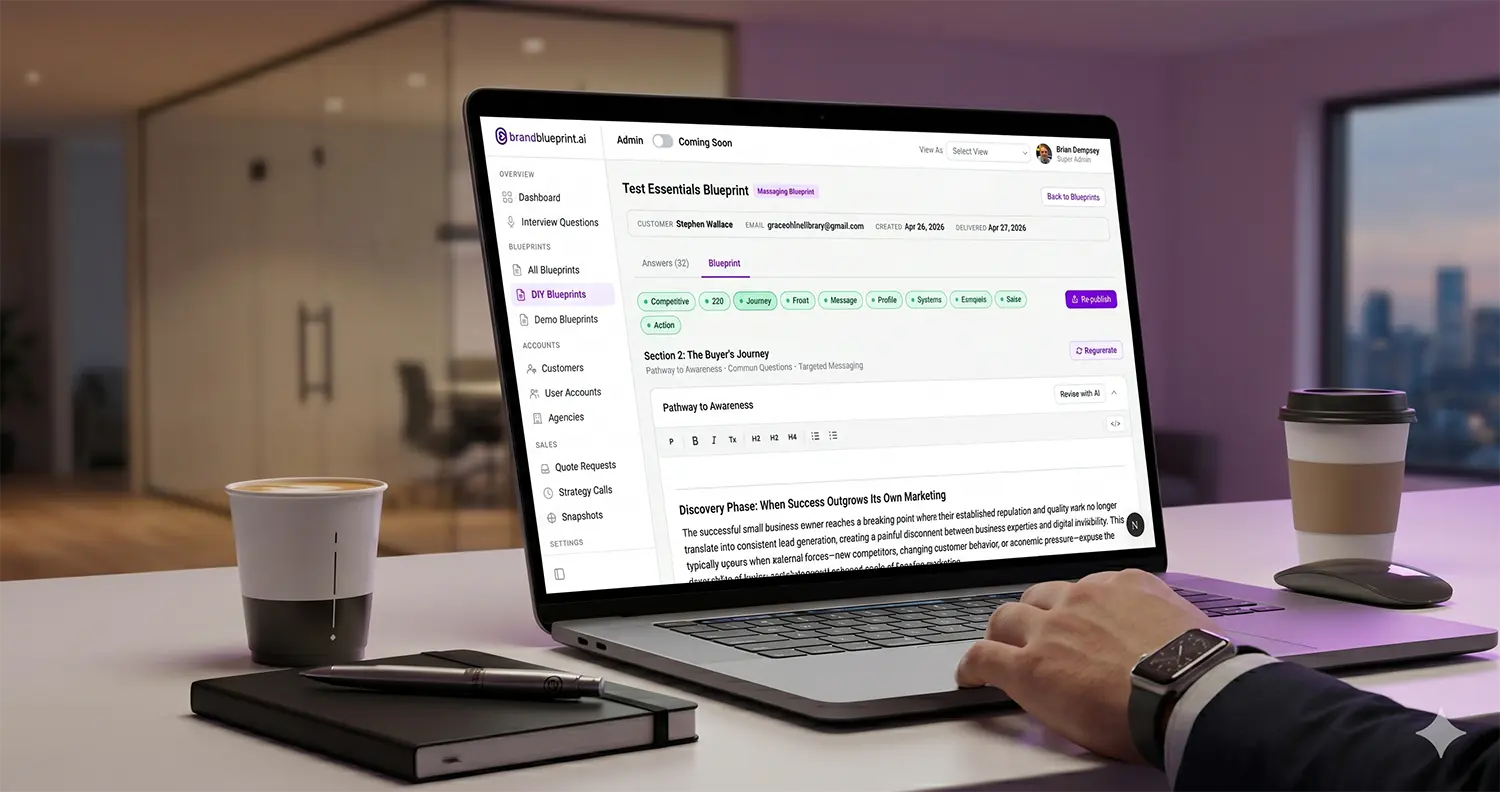
Over the last several years, building brand messaging blueprints has become one of the defining things that sets Bright Tribe apart.
Before we write a single word of website copy, develop a content strategy, or plan a single campaign — we build the blueprint. It is the foundation every other piece of work is built on.
We have now done this for over 50 clients — from London to Tokyo to Seattle — across professional services, medical practices, skilled trades, consulting firms, and B2B businesses. And what we have learned from those engagements led us to build something we could not find anywhere else in the market.
What Is a Brand Messaging Blueprint?
A brand messaging blueprint is a comprehensive strategic document that answers the questions most businesses have never clearly sat down to answer: Who are you actually for? What do you offer that no one else does? Why should someone choose you over every other option available to them?
It is not a logo guide. It is not a brand deck. It is not a mission statement on a wall.
A brand messaging blueprint is the strategic core of your brand — your positioning, your value proposition, your voice, your competitive differentiation — documented clearly enough that anyone on your team, any outside creative, or any AI tool can work from it and stay on-message.
When it is built well, it is one of the most durable assets a business owns.
What We Learned Building 50+ Messaging Blueprints for Clients
When we first started delivering these documents, we thought of them primarily as a strategy tool — a project kickoff artifact that informed downstream work like website copy and content strategy.
What we did not anticipate was how many other ways clients would put them to use.
New hire onboarding. Instead of hoping a new employee absorbs the brand through osmosis, clients hand them the blueprint. Within an hour, that person understands who the company is, who they serve, what they stand for, and how to talk about it.
Website copy and redesign. When a designer or copywriter has a brand messaging blueprint in hand, the entire project changes. There is no guessing about what the brand should sound like or what the homepage needs to say. The strategy is already done.
Sales and customer service alignment. When every person talking to a customer is working from the same strategic foundation, the pitch stops shifting depending on who picks up the phone.
Social media and blog content strategy. Instead of posting to fill a calendar, clients use the blueprint to guide what they talk about, how they say it, and why it matters to their audience.
Training AI tools. This has become increasingly common. Clients upload their messaging blueprint into ChatGPT or other AI tools so that every piece of AI-generated content sounds like them — not like a generic language model running on empty context.
The pattern across every client: a well-built brand messaging blueprint is not a one-time deliverable. It is a business asset that compounds over time.
The Problem We Kept Running Into
The blueprint has always been one of the most valuable things we deliver. It has also always been one of the most time-intensive.
Building a great one requires deep research into the client’s industry, competitors, and buyer psychology — plus significant back-and-forth to surface the strategic insights that make the final document genuinely useful. That means it has historically been priced and paced like a full agency engagement.
Which puts it out of reach for a lot of businesses that need it most.
We kept seeing the same scenario: a business owner with unclear messaging, a website that was not converting, and a pitch that changed every time someone on the team told it. They knew something was off. But a $10,000 strategy engagement was not in the cards.
That gap frustrated us for a long time. So we built a solution.
The Natural Evolution: BrandBlueprint.ai
After years of refining our methodology across 50+ client engagements, we turned our framework into a platform.
BrandBlueprint.ai takes the same brand messaging blueprint process we have used with clients worldwide and delivers it through a guided questionnaire any business owner can complete in under an hour. The platform draws on a deep proprietary research library covering buyer psychology, competitor dynamics, and industry-specific messaging patterns across dozens of markets. It is powered by Claude AI from Anthropic, with Perplexity AI providing real-time competitive research.
The output is not a chatbot conversation or a generic template. It is a set of structured, professional brand strategy documents — ready to hand to your designer, copywriter, sales team, or AI tools the same day.
Two self-serve tiers are available:
- Blueprint Essentials ($297) — Core positioning, value proposition, and brand voice. About 30 minutes to complete. Includes a Competitive Snapshot.
- Blueprint Foundations ($497) — The complete six-document suite: Core Messaging Blueprint, Competitive Intelligence Report, Sales and Content Toolkit, Implementation Guide, Brand Insights, and Writing Guidelines formatted specifically for use with AI tools. About an hour to complete.
Before you purchase, there is a free Competitive Snapshot available — enter your website and up to three competitor URLs and the platform generates a structured competitive messaging analysis so you can see the quality of the output before committing.
For marketing agencies and consultants, an Agency Plan is available to run the blueprint process on behalf of clients.
Why a Brand Messaging Strategy Matters More Right Now
AI has made it easier than ever to produce content at scale. What it has not solved is the strategy behind the content. Without a clear brand messaging framework, you are just producing more noise faster, and training your AI tools on nothing.
The businesses cutting through right now have clarity. They know who they are, who they serve, and what they stand for — and that clarity shows up in every customer interaction, every piece of content, and every sales conversation.
A brand messaging blueprint creates that clarity. It always has. Now it is accessible to any business ready to build one. Check out BrandBlueprint.ai.